

How UK Aerospace is Soaring to Net Zero
While the pressure to address climate change increases, the UK aerospace industry is at the forefront of efforts to achieve net zero emissions. With aviation playing a crucial role in the country’s economy, contributing around £29 billion to the GDP and supporting nearly one million jobs, the sector faces significant challenges and opportunities in its quest for sustainability.
In response, key industry bodies such as the AGP (Aerospace Growth Partnership), the ATI (Aerospace Technology Institute) and Sustainable Aviation have set ambitious targets and developed comprehensive strategies to drastically reduce the industry’s carbon footprint. Collectively, these strategies align with the government’s broader Jet Zero Strategy which aims for the sector to be net zero by 2045.
Breakdown of emissions
The aerospace industry currently produces around 13% of the UK’s total GHG emissions.
In 2022, aerospace manufacturing and international and domestic flights accounted for nearly 35 million tonnes of carbon emissions. Around 28.5 MtCO2e came from international flights, and 2 MtCO2e came from domestic flights, leaving an estimated 4.5 MtCO2e coming from aerospace manufacturing.
Flight emissions
From 2005 to 2019, emissions from international and domestic flights have remained consistent, with just a 1% increase in that timeframe, despite passenger numbers increasing by around 30% – which equates effectively to an impressive ~30% reduction in emissions per passenger. The reductions have been largely driven by changes in the technology being used and older planes being decommissioned and replaced by newer, more efficient models.
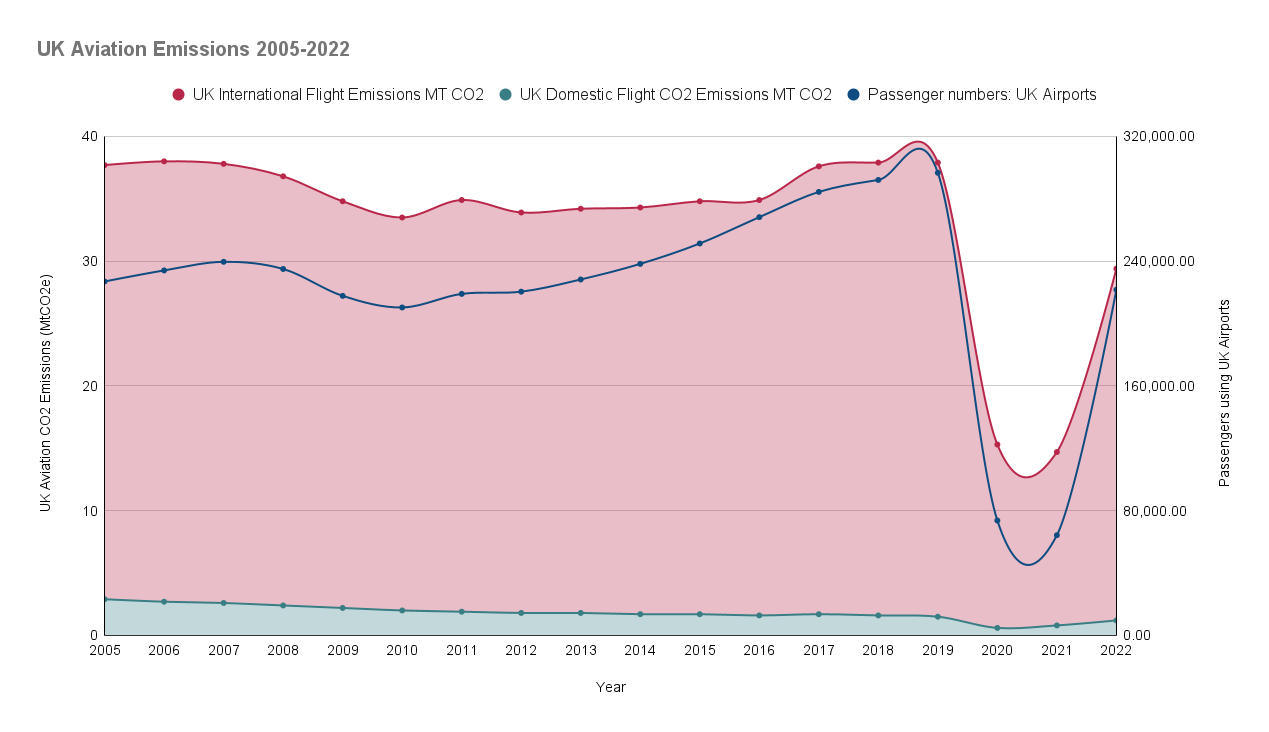
As for what happened in 2020, the chart clearly shows the impact of the Coronavirus pandemic, as the emissions from international flights dropped by 61%. In 2021, the sector was still recovering, so these figures are considered anomalies when reporting.
The aviation industry’s net zero challenge
The government’s net zero strategy from 2021 predicted that aviation will be one of the UK’s largest residual emitting sectors by 2050. This is hardly surprising when you consider that the emissions from fuel make up almost 90% of the sector’s emissions. Air travel currently has no reliable, sustainable alternative to the fuel challenge, and the volume of passengers is predicted to increase between now and 2050.
Jet Zero, the ATI, the AGP and Sustainable Aviation all agree that although the amount of GHG emissions is relatively low compared to other industries, the success of air travel should not be at the planet’s expense.
Decarbonising aviation outside the manufacturing process will rely on innovation and cross-sector collaboration to produce sustainable fuels and design new aircraft. It’s worth noting that this is not a challenge unique to the UK, and there will be a competitive ‘race to Net Zero’ with other countries innovating and creating additional competitive challenges for UK manufacturers.
The ‘Jet Zero’ strategy
The government is introducing a CO2 emissions reduction trajectory that ranges from 2025 to 2050, which is based on their “High ambition” scenario. It sets ambitious in-sector targets of 35.4 MtCO2e in 2030, 28.4 MtCO2e in 2040, and 19.3 MtCO2e in 2050.
This strategy has three main areas of focus; international leadership, partnership delivery, and maximising opportunities. These then feed into the six measures they want to achieve:
ATI road map to net zero
The ATI (Aerospace Technology Institute) has also set out its road map to Net Zero, in which they mention that four main areas of technology need to be addressed before net zero can be achieved. They are:
Aerospace manufacturers tackling net zero
The starting point for any net zero strategy should be to understand where emissions happen, and that not all emissions are equal. Understanding the difference between Scope 1 and Scope 2 emissions, and Scope 3 emissions is a critical starting point.
For the aerospace manufacturing industry, Scope 3 (downstream) emissions will account for the majority of the total value chain emissions, but that doesn’t mean that Scope 1 and Scope 2 emissions do not matter.
Many manufacturers are working on cutting back their emissions and how their sustainability actions can help not only reduce their emissions but also flow down the value chain.
Examples of net zero plans in action
Airbus has reduced Co2 emissions by 26% between 2015 and 2021 and has set targets to reduce scope 1 & 2 emissions by 63% by 2030. They want to secure up to 90% of their energy use through renewable or low-carbon electricity for all sites and replace all the lighting, heating, and steam systems from high-carbon systems to using biomass or geothermal solutions.
Airbus is also forging relationships with partners to help develop technologies that will help with sustainability in the long run, mainly focusing on their Scope 3 emissions. Projects include signing a memorandum of understanding with Neste to advance the production of Sustainable Aviation Fuel (SAF) and investing in Hy24’s Clean H2 Infra Fund which will help boost the global hydrogen economy and invest in hydrogen projects worldwide.
GKN Aerospace has set some ambitious targets to reduce its environmental impact, including; reducing Scope 1 and Scope 2 emissions by 50% by 2030; investing at least 80% of its R&D spend into programmes that aid aerospace decarbonisation by 2025, and 100% of new product launches will contribute to decarbonisation by 2025.
Example projects so far have included repurposing 2 tonnes of LED lights from the closed Kings Norton site and replacing the old fluorescent lights in its Filton site, a project that is estimated to have paid for itself within 12 months and delivering ongoing annual savings, installing Solar PV at their Trollhattan site, with three more solar projects planned in 2024, and plans for a solar panel field at the Cowes site, which is expected to generate 20% of the site’s annual electricity consumption.
The board also aims to reduce Scope 3 emissions by 25% before 2030. It will do this by looking at its full value chain and working with suppliers, customers, and partners to push aviation forward to achieve net zero by 2050.
Summary
The UK aerospace industry faces huge challenges to meet its goal of achieving Net Zero by 2045. The UK government along with the ATI, AGP and Sustainable Aviation believe that with the efforts of the entire industry, from manufacturers to airlines and airport operations, it will be possible. By using new technology to become more efficient, and sustainably decarbonise the industry, the sector will be able to continue to evolve and grow to meet the demands of the sector.
Businesswise Solutions is on hand to guide aerospace manufacturers to maximise their energy efficiency efforts, become more sustainable, and work towards Net Zero.
Businesswise Solutions is a proud member of the North West Aerospace Alliance.
Connect with us
Want more insights like this? Sign up for EnergyIntels and stay informed with the latest industry updates.
More From EnergyIntel

Energy Security 2026: Managing Energy Market Risk
Energy Security in 2026: What Businesses Can Control in a Volatile Energy Market Geopolitical instability, volatile gas markets and structurally high UK electricity costs [...]
How a foil manufacturer uncovered £4 million in energy savings
How one foil manufacturer put £4 million back into the business The way energy is bought, managed and accounted for can have a significant impact on operating costs, [...]
How hidden energy costs led to £3 million of savings for one UK glass recycler
How One Glass Recycler Turned Hidden Energy Costs Into £3 Million of Savings Most businesses assume they're paying the right amount for their energy. It's one of those [...]