

How Technical Energy Cost Structures Are Redefining Energy Strategy
When boards turn their attention to energy, the conversation almost always begins in the same place: procurement. What rate did we secure? Who is our supplier? When does the contract expire?
These are valid questions. But they focus on a decision that comes too late in the process.
By the time a contract is signed, a substantial share of energy cost has already been set. Not by wholesale markets or supplier negotiations, but by the way a site is configured to interact with the network – how capacity is defined, how demand is measured, and how charges are applied.
These underlying decisions form your technical energy cost structures. In many organisations, they were established years ago and have remained largely untouched. Yet they now play a decisive role in cost performance, despite rarely being discussed at leadership level.
The shift that has changed the stakes
Energy strategy has traditionally been built around two levers: reducing consumption and securing competitive unit rates. Both still matter. But they now influence a smaller share of total cost than most leadership teams realise.
Regulatory reform, most notably the Targeted Charging Review, alongside broader changes to network charging, has fundamentally altered how costs are constructed. Charges that were once variable are increasingly fixed. Network and residual costs are rising, harder to predict, and less directly linked to how much energy a business consumes.
A business can improve efficiency, manage demand effectively, and negotiate strong procurement terms, yet still see costs drift in the wrong direction. This is because performance is now heavily influenced by how technical energy cost structures are set up in the first place.
Where cost is actually being determined
Five structural elements sit within the technical layer and together shape a material portion of your energy cost base:
Network charging structures have become more complex, more location-specific, and more fixed in nature. Costs are increasingly shaped by how your site sits within the network, not simply by how much energy flows through it.
Contracted capacity is no longer a passive setting. Charges now penalise to both overstated and understated kVA, meaning capacity set against historic peak demand (from operations that may no longer exist in that form) locks in cost that has no operational justification.
DUoS charging bands mean distribution costs vary significantly depending on when energy is consumed. Without clear visibility, many businesses absorb higher charges without ever actively managing them.
TNUoS and residual charges continue to grow in scale and complexity. For many leadership teams, they appear simply as unexplained variance rather than defined, controllable cost drivers.
Losses factors and metering configuration influence how consumption is adjusted and billed. When misaligned with operational reality, they can introduce costs that are technically valid but commercially inaccurate.
None of these elements trigger alarms, and none of them appear obviously in board papers. But together, they form the energy cost structure that underpins your entire energy strategy.
A layer without an owner
The Three Layers framework (technical, operational, and commercial) gives leadership teams a clear structure for understanding energy strategy in full.
The commercial side, contracts, suppliers, and market positioning, typically sits with procurement or finance. The operational side, consumption, efficiency, and carbon reduction, is increasingly visible through sustainability teams.
But ownership of the technical layer is unclear.
It sits in a quiet corner of the business, owned by no one in particular, and assumed by everyone to have already been handled. This assumption is one of the most expensive in an energy strategy.
Technical arrangements are usually set during site commissioning or at the start of a supply agreement. From that point, they tend to persist without review. Over time, however, businesses evolve. Processes change. Demand profiles shift.
The technical layer, left untouched, stops reflecting reality, and the gap between configuration and reality is where cost quietly compounds.
Why technical energy cost structures require leadership attention
It would be easy to view these energy cost structures as a technical matter best left to engineers or energy consultants. But that perspective underestimates their impact.
These structural settings determine whether a business is paying for unused capacity, whether non-commodity charges are being applied correctly, and whether the cost base itself reflects current operations. Every procurement decision and efficiency initiative sits on top of this foundation.
Without visibility, leadership teams are making decisions on an incomplete picture.
A well-negotiated contract cannot compensate for a misaligned cost base. Nor can operational improvements fully offset structural inefficiencies that have never been challenged.
Ownership at board level does not mean becoming technical experts. It means recognising that this layer exists, assigning accountability for it, and ensuring it is reviewed with the same discipline applied to commercial decisions.
Questions leadership teams should be asking
For most businesses, improving energy strategy begins with asking a small number of direct questions:
If these questions cannot be answered with confidence, there is a strong likelihood that the technical layer carries unexamined risk.
Building strategy on the right foundation
The technical layer of energy strategy rarely attracts attention. It does not carry the visibility of procurement decisions or the profile of net zero commitments. But it defines the conditions in which both must operate.
Operational improvements deliver less value when the cost base is misaligned. And commercial strategy achieves less when built on outdated assumptions. The effectiveness of both depends on the integrity of the underlying structure.
Businesses that recognise this are beginning to treat technical energy cost structures as a core strategic consideration rather than a background detail. They introduce clear ownership, build in periodic review, and ensure alignment between infrastructure and operations.
The result is not just better cost control but a more complete and resilient energy strategy.
Because increasingly, the question is not simply what you pay for energy, but how that cost was determined long before you entered the market.
And that is where leadership attention now matters most.
If you want to understand whether your technical energy cost structures still reflect how your sites operate and where misalignment may be driving unnecessary cost, an Energy Exposure Assessment can help.
Connect with us
More energy insight from EnergyIntel

Energy Security 2026: Managing Energy Market Risk
Energy Security in 2026: What Businesses Can Control in a Volatile Energy Market Geopolitical instability, volatile gas markets and structurally high UK electricity costs [...]

How a foil manufacturer uncovered £4 million in energy savings
How one foil manufacturer put £4 million back into the business The way energy is bought, managed and accounted for can have a significant impact on operating costs, [...]

How hidden energy costs led to £3 million of savings for one UK glass recycler
How One Glass Recycler Turned Hidden Energy Costs Into £3 Million of Savings Most businesses assume they're paying the right amount for their energy. It's one of those [...]
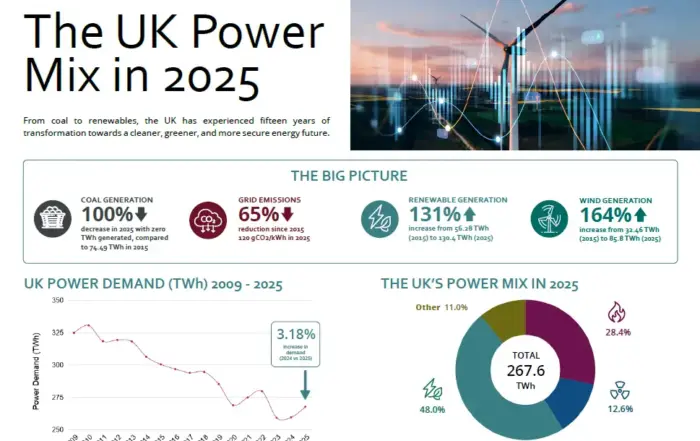
UK Power Generation Mix in 2025
The UK Power Mix in 2025 How the UK’s electricity system has been transformed Over the past 15 years, the UK electricity system has undergone one of the fastest [...]

Technical Energy Cost Structures and Their Impact on Energy Strategy
How Technical Energy Cost Structures Are Redefining Energy Strategy When boards turn their attention to energy, the conversation almost always begins in the same [...]

Why energy procurement risk is no longer just a cost decision
Why energy procurement risk is no longer just a procurement issue For many senior leaders, energy still appears in the P&L as a cost [...]