

The UK Power Mix in 2025
How the UK’s electricity system has been transformed
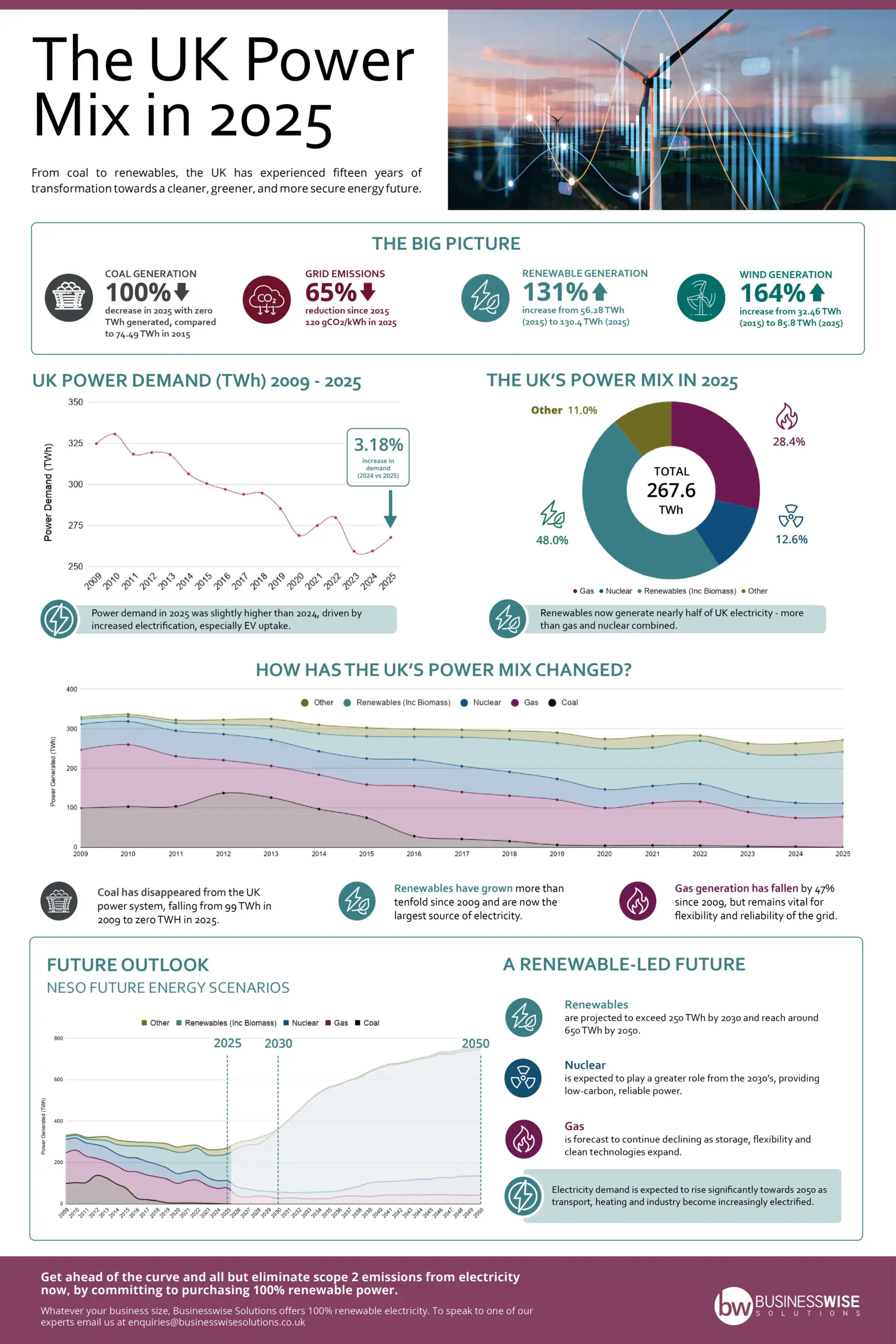
Over the past 15 years, the UK electricity system has undergone one of the fastest energy transitions seen anywhere in the world. In 2009, coal and gas dominated power generation, renewables played only a minor role, and the grid remained heavily carbon-intensive.
Fast forward to 2025, and the picture looks dramatically different. Coal generation has effectively disappeared, renewables have become the largest source of electricity generation, and the UK grid is now significantly cleaner than it was just a decade ago.
The latest UK power mix data highlights how rapidly the nation’s electricity landscape has evolved and where it may be heading next.
Coal has reached the end of the line
In 2012, coal generated more than 137 TWh of electricity in the UK. By 2025, that figure had fallen to effectively zero.
The speed of this decline has been rapid. Coal was once the backbone of the UK grid, but rising carbon costs, ageing infrastructure, environmental policy, and the rapid growth of renewables have steadily pushed it out of the market.
The disappearance of coal represents one of the clearest indicators of the UK’s progress towards decarbonisation and demonstrates how quickly electricity systems can change when policy, economics, and technology align.
Renewables now dominate the UK power mix
At the same time coal has declined, renewable generation has surged to replace it.
Renewables, including biomass, generated over 130 TWh in 2025 compared with just 12 TWh in 2009, this is an increase of more than tenfold.
Renewables are now the single largest source of electricity generation in the UK, overtaking gas and substantially outperforming nuclear generation.
This shift has fundamentally altered the structure of the UK power system. Where fossil fuels once dominated generation, renewable technologies now form the core of the electricity mix.
Wind power is driving the transition
The growth of renewables has largely been driven by wind generation, particularly offshore wind.
Wind output increased from less than 9 TWh in 2009 to almost 86 TWh in 2025.
The UK’s geography, investment in offshore infrastructure, and continued expansion of wind capacity have positioned wind energy as the central pillar of the country’s energy transition.
Future projections suggest this trend is only likely to accelerate further. The data forecasts substantial continued growth in offshore wind generation through to 2050, reinforcing the UK’s ambition to become a global leader in renewable electricity generation.
Solar generation continues to accelerate
Solar generation has also continued its steady upward trajectory. From virtually no contribution in 2009, solar generation reached more than 17 TWh in 2025.
While solar remains smaller than wind in overall contribution, falling technology costs and increasing deployment mean it is becoming an increasingly important part of the UK generation mix.
Combined, wind and solar are now reshaping how electricity is produced and consumed across the country.
Gas still plays a critical balancing role
Despite the rapid rise of renewables, gas generation remains an important component of the UK electricity system.
Gas generated around 77 TWh in 2025, down significantly from historic highs of more than 150 TWh in the early 2010s.
Although its overall share has declined, gas continues to provide flexibility and system balancing support when renewable output fluctuates. This highlights one of the ongoing challenges of the energy transition: ensuring security of supply while increasing reliance on intermittent renewable generation.
Over time, technologies such as energy storage, hydrogen, interconnection, and carbon capture may gradually reduce the UK’s dependence on unabated gas generation.
Nuclear generation has declined for now
Nuclear power has historically provided a stable source of low-carbon baseload electricity for the UK.
However, output has fallen steadily over recent years as older nuclear stations have closed or reduced generation. Nuclear output fell from around 65 TWh in the early 2010s to approximately 34 TWh in 2025.
Despite this recent decline, long-term projections suggest nuclear generation will recover later in the decade and beyond as new projects come online.
A key driver behind this future investment is the Nuclear Regulated Asset Base (RAB) scheme, which was introduced to support the financing of new nuclear developments. The RAB scheme is expected to play an important role in enabling the next generation of UK nuclear infrastructure, supporting long-term energy security while providing reliable low-carbon baseload power to complement the growth of renewable generation.
The UK grid is cleaner than it was a decade ago
One of the most important outcomes of the changing power mix has been the reduction in grid carbon intensity.
In 2009, the UK electricity grid emitted approximately 451 gCO₂/kWh. By 2025, that figure had fallen to around 120 gCO₂/kWh.
This reduction reflects the combined impact of:
The decarbonisation of electricity is increasingly important because many sectors, including transport, heating, and industry, are expected to electrify over the coming decades.
Electricity demand is expected to rise
Interestingly, overall UK electricity demand today remains lower than historic levels seen in the early 2010s. Efficiency improvements, economic changes, and reduced industrial demand have all contributed to this trend.
However, future energy scenarios suggest electricity demand could rise substantially over the coming decades as:
This means the challenge ahead is not only decarbonising generation further, but also expanding the electricity system significantly to meet growing demand.
A transformed electricity system
The UK’s power mix in 2025 tells the story of a system that has been fundamentally reshaped in little more than a decade. However the transition is far from complete.
According to NESO’s Future Energy Scenarios, delivering a secure, low-carbon energy system will depend on continued investment in energy efficiency, system flexibility, infrastructure, and low-carbon technologies.
As electricity demand increases through electrification, manufacturers and energy-intensive businesses will play an important role in supporting the transition. Improving energy efficiency, adopting low-carbon technologies, and developing more flexible energy strategies can help businesses reduce costs, improve resilience, and lower emissions.
Businesses that begin adapting now will be better positioned to succeed as the UK moves towards a cleaner and increasingly renewable electricity system.
Previous UK power mix generation reviews:
Connect with us
Want more insights like this? Sign up for EnergyIntels and stay informed with the latest industry updates.
More From EnergyIntel

Energy Security 2026: Managing Energy Market Risk
Energy Security in 2026: What Businesses Can Control in a Volatile Energy Market Geopolitical instability, volatile gas markets and structurally high UK electricity costs [...]

How a foil manufacturer uncovered £4 million in energy savings
How one foil manufacturer put £4 million back into the business The way energy is bought, managed and accounted for can have a significant impact on operating costs, [...]

How hidden energy costs led to £3 million of savings for one UK glass recycler
How One Glass Recycler Turned Hidden Energy Costs Into £3 Million of Savings Most businesses assume they're paying the right amount for their energy. It's one of those [...]