

Breaking Down Your Electricity Invoice
What manufacturers need to know about their energy costs.
With increasing material costs, supply chain disruptions, and volatile market demands, manufacturers are under increasing pressure. On top of these pressures, managing rising energy costs has become critical for protecting business profitability. For manufacturers, electricity isn’t just a cost, it’s often one of the largest overheads impacting operational efficiency and competitiveness.
A good starting point to manage energy costs effectively is for a manufacturer to understand the makeup of their electricity invoices. Below, we’ll break down the key elements of an electricity invoice, showing what you get charges for and why, as well as outline actionable steps manufacturers can take to manage their energy costs better.
Unit Rate Breakdown
The electricity you pay for is made up of different cost elements, which can be allocated into one of three categories.
- 1
Wholesale Energy Costs: This is the actual cost of electricity you consume. The wholesale cost is determined by market conditions and currently accounts for approximately 44.8% of your overall invoice (2024/2025).
- 2
Transmission and Distribution Costs: These are sometimes known as Network and Balancing charges and are required by the District Network Operators (DNOs) and the National Grid in order to deploy and maintain the electricity infrastructure to ensure security of supply to all UK electricity consumers. These costs are approximately 24.7% of your overall invoice (2024/2025).
- 3
Environmental Taxes and Levies: Government-imposed charges to support environmental initiatives and ensure the stability of the energy market. Over the last 10 years, this has been the single largest contributor to overall energy prices increasing and currently accounts for approximately 30.5% of your overall invoice (2024/2025).
The below chart shows the yearly unit rate breakdown of these costs since 2018/2019, with forecasted costs for 2025 – 2029. What it clearly shows is that the combined charges for Transmission and Distribution and Environmental Taxes and Levies, now make up over 50% of your electricity bill, and this is expected to rise to 66% in 2028/2029.
Electricity Invoice Break Down: Unit Rate 2018 – 2024 (Forecast 2025 – 2029)
Wholesale Energy Costs
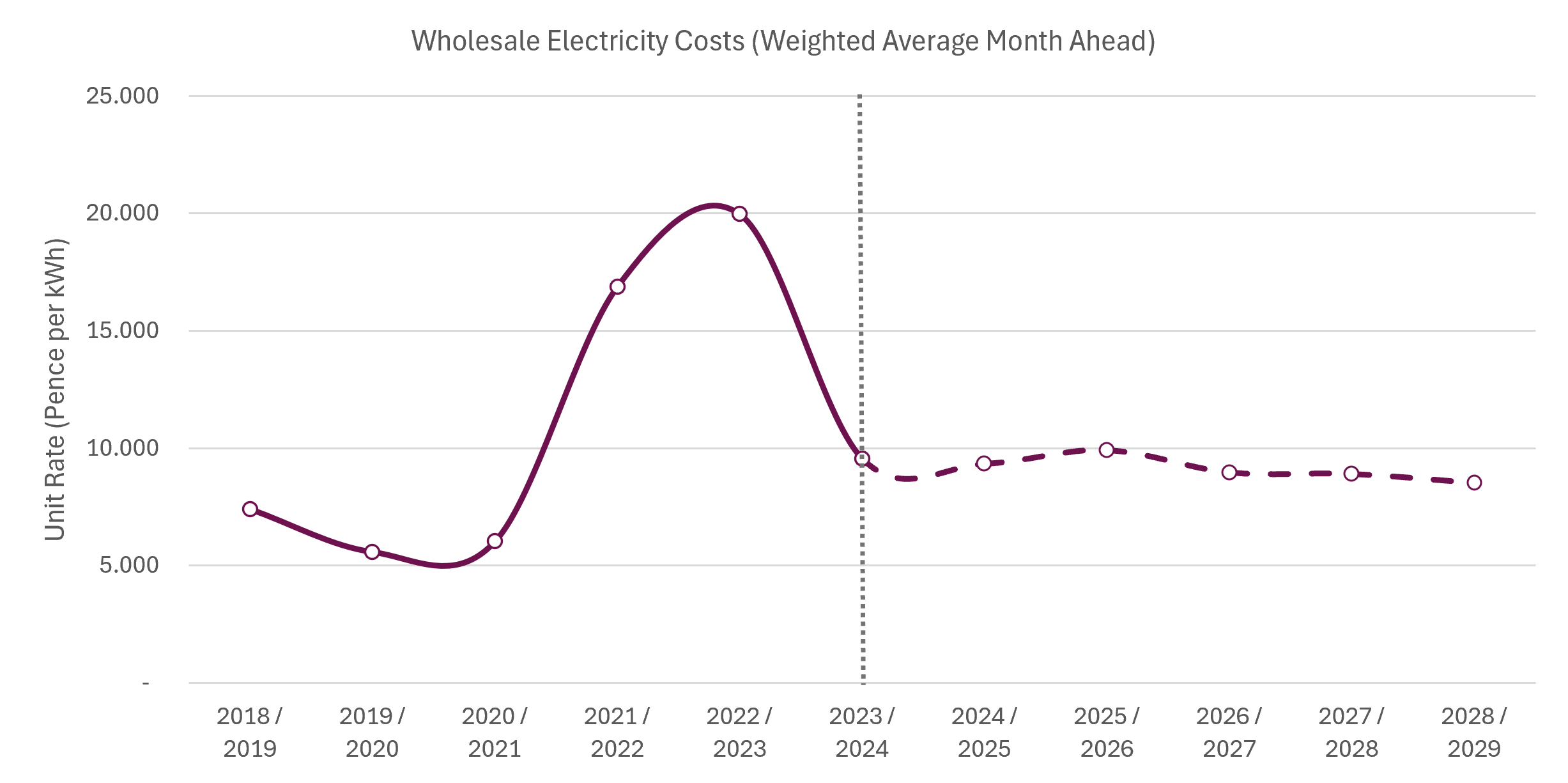
The way electricity and gas are purchased in the UK makes it challenging to show the true wholesale rate for an entire year, as each season is traded independently and different businesses deploy different strategies to achieve varying results.
For the below graph, we have used the month-ahead pricing for each season and blended the summer and winter seasons to get to a pence per kWh unit rate for each financial year. The spike in 2021/22 and 2022/23 was caused primarily by the Russia/Ukraine conflict. The prices have settled down, albeit still higher than 2020 levels, with our analysts predicting prices to remain at these levels for the foreseeable future.
Wholesale electricity costs are driven by market dynamics such as:
Managing wholesale costs.
For manufacturers, managing wholesale costs effectively means they can reduce the amount they are charged on 40% of their overall energy costs. Having a strategic procurement strategy in place, like a flexible purchasing strategy, for instance, will let manufacturers take advantage of market trends and secure energy at favourable times to minimise costs.
It’s important to remember that effective energy procurement is not just about securing lower rates, it’s also about aligning your purchasing strategy with your operational and financial goals.
Transmission and Distribution Costs
Electricity invoices include several transmission and distribution charges, which ensure electricity is delivered efficiently and securely.
These charges have been stealthily increasing over the last 20-30 years and more recent changes mean that a higher percentage of charges are based on fixed daily costs rather than indexed to consumption. You can read more about that here.
The main transmission and distribution costs that manufacturers should be aware of are:
Managing Transmission and Distribution charges.
Manufacturers should assess whether their site’s voltage and capacity (measured in kVA) are accurately classified and utilised. Businesses that are not using their capacity will now find that they are paying a premium on TNUoS, DUoS, and BSUoS charges.
When it comes to transmission and distribution charges, the goal for manufacturers is to have a flat consumption profile rather than one that has peaks and troughs. Rescheduling energy-intensive processes, sometimes referred to as ‘load shifting’, will have the biggest impact on transmission and distribution charges because of the potential to reduce the banding used to calculate DuoS and TNuoS charges.
Reducing overall demand is still a practical way to lower transmission and distribution charges, as some elements are still linked to consumption, but a general reduction in consumption will have a much bigger impact on wholesale costs and environmental taxes and levies.
Environmental Taxes and Levies
Taxes and levies are significant contributors to energy costs for manufacturers. They are essentially a group of charges designed to provide income which can be used to fund government initiatives and environmental programs.
Managing Environmental Taxes and Levy charges.
As all environmental taxes and levies are based on a fixed pence per KWh and charged to every KWh consumed, reducing consumption has a direct impact on these charges, i.e. A business that can reduce consumption by 20% will reduce these charges by 20%.
Outside of reducing consumption, businesses should explore levy exemptions to determine if their business qualifies for government relief from any of these charges. Staying up to date on government policies and schemes that offer financial incentives or relief for manufacturers is something many of our clients trust us to do on their behalf.
Download ‘Understanding Your Energy Bill’.
To gain deeper insight into how your electricity invoice is broken down and the projected costs for the next five years, download our Understanding Your Energy Bill guide. This comprehensive guide breaks down each element of your energy invoice and offers actionable strategies for manufacturers to manage and optimise their energy spending.
Connect with us
Want more insights like this? Sign up for EnergyIntels and stay informed with the latest industry updates.
More From EnergyIntel

Energy Security 2026: Managing Energy Market Risk
Energy Security in 2026: What Businesses Can Control in a Volatile Energy Market Geopolitical instability, volatile gas markets and structurally high UK electricity costs [...]

How a foil manufacturer uncovered £4 million in energy savings
How one foil manufacturer put £4 million back into the business The way energy is bought, managed and accounted for can have a significant impact on operating costs, [...]

How hidden energy costs led to £3 million of savings for one UK glass recycler
How One Glass Recycler Turned Hidden Energy Costs Into £3 Million of Savings Most businesses assume they're paying the right amount for their energy. It's one of those [...]