

Insight Whitepaper: UK Manufacturing and the Race to Net Zero
The UK manufacturing sector plays a pivotal role in the national push to reach net zero emissions by 2050. While industry now accounts for around 14% of total UK emissions, it remains one of the most complex sectors to decarbonise due to high energy intensity, technological constraints, and global supply chain dependencies.
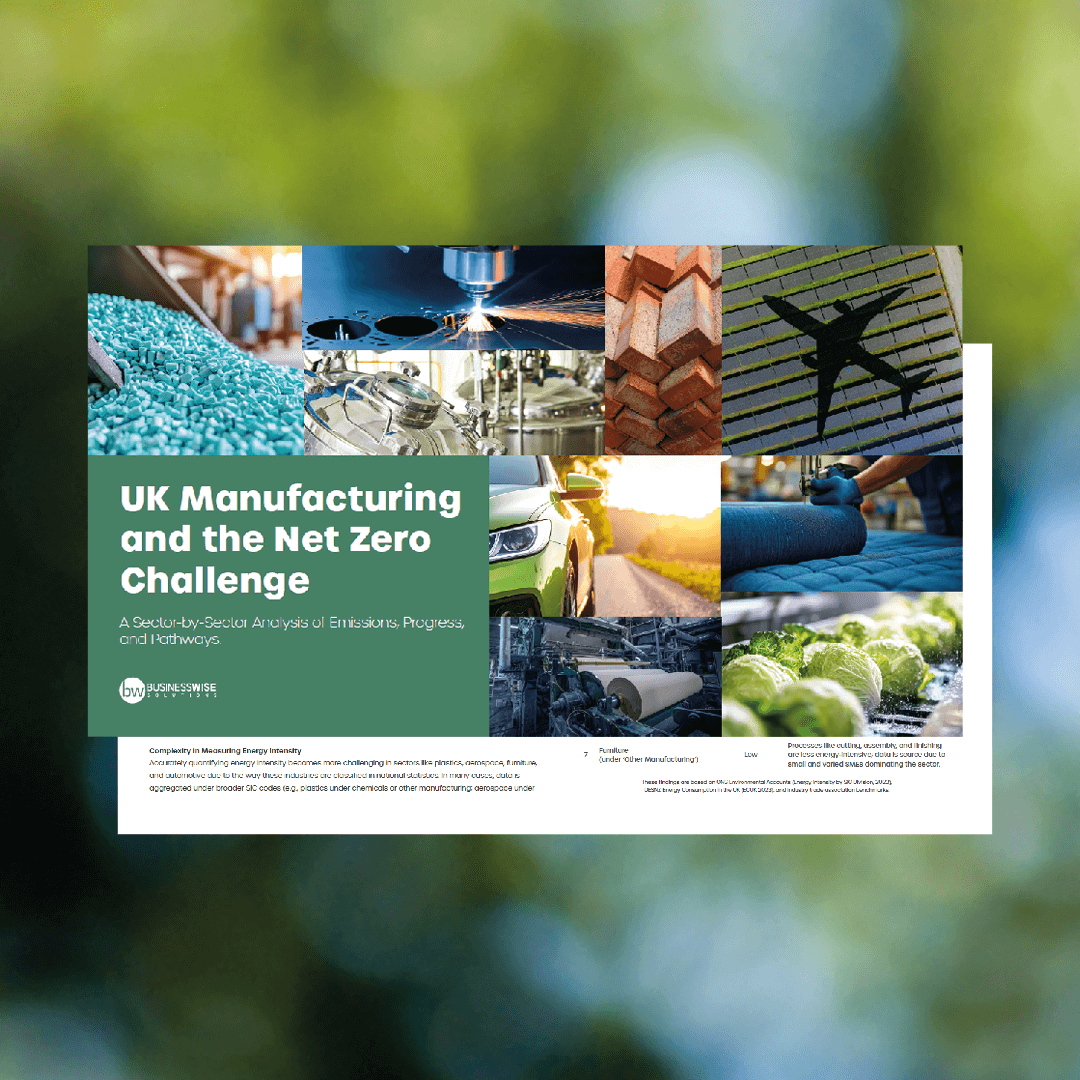
Our new whitepaper, UK Manufacturing and the Net Zero Challenge, compares how eight core sectors are responding to this challenge: aerospace and automotive, building products, chemicals, food and drink, furniture and textiles, metals, plastics, and wood and paper. Based on the latest data from the Office for National Statistics (ONS), industry associations, and our expert insight, the whitepaper offers an evidence-led view of decarbonisation across UK industry.
Which sectors are driving industrial emissions?
Using the latest data from the ONS, the white paper highlights the manufacturing sectors with the highest emissions footprints:
Chemicals Industry: The UK chemicals sector is the single largest contributor to manufacturing emissions. In 2023, it accounted for 28% of the sector’s emissions, that’s over 19,400 kilotonnes of CO₂e, and contributed more than 5% of total UK greenhouse gas emissions. With complex processes like steam cracking and around-the-clock operations, the sector’s reliance on both heat and electricity makes decarbonisation highly technical and capital intensive.
Metals Industry: Responsible for 21% of manufacturing emissions in 2023, equalling around 14,800 kilotonnes of CO₂e, metals manufacturing remains a major emitter due to high-temperature steel and aluminium production. Coking coal use and intensive electricity demand are central challenges, but low-carbon steel technologies such as hydrogen-based direct reduction are beginning to emerge.
Building Products Industry: Cement, glass, and brick production made this the third-largest emitter in 2023, responsible for 15% of manufacturing emissions (10,847 kilotonnes of CO₂e). High-temperature kilns and furnaces make electrification and fuel switching difficult, though innovation is accelerating.
Food & Drink Industry: This sector contributed 10% of UK manufacturing emissions in 2023, equivalent to 7,263 kilotonnes of CO₂e. Its footprint is driven by energy-intensive processes like baking, brewing, refrigeration and sterilisation, alongside 24/7 operations and complex supply chains.
These four industries alone represent nearly three-quarters of UK manufacturing emissions, highlighting where targeted support and innovation could have the biggest payoff.
Decarbonisation strategies across sectors
One of the key findings of the whitepaper is that there is no single route to decarbonisation. Each sector is adopting strategies that reflect its specific processes, technologies, and constraints.
Electrification: From automotive plants transitioning to electric heat sources, to food and drink manufacturers replacing fossil fuel boilers with electric steam generators, electrification is helping companies cut operational emissions while integrating renewable power.
Hydrogen Solutions: In sectors where electric heat can’t meet process requirements, like metals and aerospace, hydrogen offers a long-term solution. Early pilots in hydrogen steelmaking and hydrogen-powered flight suggest growing momentum, despite infrastructure and cost barriers.
Energy Efficiency and Process Optimisation: Many sectors, including furniture and plastics, are achieving gains through lean manufacturing, automation, smart metering and heat recovery. These interventions often deliver short-term cost savings alongside emissions reductions.
Alternative Materials and Circular Economy: Sectors like aerospace and automotive are innovating with lightweight materials and recycled components to reduce lifecycle emissions. Plastics manufacturers are trialling bio-based polymers and chemical recycling to reduce dependency on fossil-based feedstocks.
These varied approaches demonstrate the complexity of the challenge and highlight why progress is uneven across the sector.
The role of energy and what can manufacturers do now
Energy is the foundation of every credible net zero strategy. How it’s sourced, managed, and consumed has a direct impact on emissions, especially for manufacturers, where energy is embedded in core processes. This means that tackling energy first is often the fastest and most cost-effective way to reduce carbon and build long-term resilience.
Manufacturers can take immediate steps to cut their Scope 2 emissions by switching to renewable electricity, whether through green tariffs, power purchase agreements (PPAs), or on-site generation such as solar PV. These changes don’t just reduce emissions; they also protect against market volatility and improve ESG performance.
Beyond sourcing, energy efficiency remains a powerful lever. Upgrading lighting, motors, and HVAC systems; recovering waste heat, or investing in real-time energy monitoring can significantly reduce consumption and operating costs. Even low-cost changes in behaviour and maintenance routines can deliver measurable results.
For Scope 1 emissions (those from fuels burned on site) businesses can explore fuel switching, combustion efficiency upgrades, and process automation. These measures, paired with smart analytics, help identify and prioritise high-impact opportunities.
Importantly, manufacturers should view energy data as a strategic asset. Monitoring tools, demand response technologies, and performance benchmarking help optimise use, avoid peak charges, and track progress against net zero goals.
Finally, government schemes remain available for eligible businesses. These incentives can unlock vital funding for energy projects. Meanwhile, collaboration across supply chains, particularly in capturing Scope 3 data is key to unlocking whole-system change.
In short: energy is both the problem and the solution. Manufacturers that get it under control now will be best placed to lead in the low-carbon economy.
Download the whitepaper
Connect with us
Our whitepaper is based on the most recently published emissions data and sector-specific insights drawn from real manufacturers. It’s designed to help operations leaders, sustainability managers and energy professionals benchmark progress and accelerate their decarbonisation journey.
Want more insights like this? Sign up for EnergyIntels and stay informed with the latest industry updates.
More From EnergyIntel

Energy Security 2026: Managing Energy Market Risk
Energy Security in 2026: What Businesses Can Control in a Volatile Energy Market Geopolitical instability, volatile gas markets and structurally high UK electricity costs [...]
How a foil manufacturer uncovered £4 million in energy savings
How one foil manufacturer put £4 million back into the business The way energy is bought, managed and accounted for can have a significant impact on operating costs, [...]
How hidden energy costs led to £3 million of savings for one UK glass recycler
How One Glass Recycler Turned Hidden Energy Costs Into £3 Million of Savings Most businesses assume they're paying the right amount for their energy. It's one of those [...]