
In light of recent shake ups in the market and the essential upgrade to half hourly meters under the P272 directive, we consider how you can really get a handle on your energy consumption and create a successful management strategy.
Use historic information to identify trends
Being able to compare this week/month/year patterns with data from last year, or even further back to previous years, provides you with a visual representation of trends within your business.
You can use this information to clarify what is the norm in terms of daily consumption patterns, as well as to identify areas where cuts might be made.
Understand what are the driving forces behind your energy usage
Being able to drill right down into individual meter data enables you to extract vital consumption information. Such data will identify high cost drivers within your business as well as showing you when and where you can expect high peaks of demand.
Having such information at your fingertips is invaluable when looking at ways to reduce these costs.
Accurate monitoring for a better future strategy
Having a complete, fully rounded understanding of your energy patterns past and present enables you to look towards creating a robust energy management strategy for the future.
Such information allows you to drill down and question the peaks and troughs of your energy usage and to see which areas of your business are using the most energy and why.
Here’s how a large site manufacturing customer used UTILITYi to reduce consumption levels across its factory:
- Machinery running two daily shifts, six days a week was proving expensive.
- Company energy manager provided times for tolerance alerts to be set up, notifying them of unusual consumption patterns.
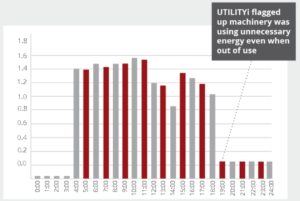
- Monitoring activity over a full week highlighted peak demand levels and that energy was being used even when the factory was closed.
- Investigation found that machinery was being left on during periods when it was out of use.
- Identification enabled the company to tackle behavioural issues among staff and monitoring ability they needed to ensure changes were made.
Energy Security 2026: Managing Energy Market Risk
Energy Security in 2026: What Businesses Can Control in a Volatile Energy Market Geopolitical instability, volatile gas markets and structurally high UK electricity costs [...]
How a foil manufacturer uncovered £4 million in energy savings
How one foil manufacturer put £4 million back into the business The way energy is bought, managed and accounted for can have a significant impact on operating costs, [...]

How hidden energy costs led to £3 million of savings for one UK glass recycler
How One Glass Recycler Turned Hidden Energy Costs Into £3 Million of Savings Most businesses assume they're paying the right amount for their energy. It's one of those [...]

How one manufacturer turned energy into a Board-Level KPI
EMaaS in Action: How One Manufacturer Turned Energy Into a Board-Level KPI Every manufacturer knows energy is a significant operational cost, but understanding where it's really being used [...]