

Energy Security in 2026: What Businesses Can Control in a Volatile Energy Market
Geopolitical instability, volatile gas markets and structurally high UK electricity costs have made energy an increasingly significant business risk. But while businesses cannot control the wholesale market, they can control how exposed they are to it.
In this webinar, in partnership with the Northern Automotive Alliance, we explore the forces shaping UK energy costs in 2026 and, more importantly, the practical steps UK businesses can take to manage risk, reduce unnecessary costs and build greater resilience.
Why energy security matters now.
The UK remains highly exposed to movements in global gas markets. Disruption in Eastern Europe, instability around the Strait of Hormuz, competition for LNG cargoes and constraints on gas supply can quickly feed through into UK wholesale prices
That exposure matters for electricity buyers too. Gas continues to play an important role in setting the marginal price of electricity, meaning movements in gas markets can have a direct impact on power costs even as the UK’s generation mix becomes increasingly renewable.
For energy-intensive industries, the consequences are particularly significant. UK electricity prices remain substantially higher than those faced by many European competitors, putting additional pressure on operating margins and international competitiveness.
From predicting prices to managing exposure.
Trying to predict the next movement in wholesale markets is not an energy strategy. A more useful question is: how much exposure is the business prepared to carry?
The webinar examines the differences between fixed, flexible, capped and collar-based purchasing strategies, and looks at how a structured hedging approach can spread purchasing decisions across time rather than concentrating risk on a single renewal date.
This means matching procurement decisions to your appetite for risk, budget requirements and consumption profile – protecting more volume where exposure is greatest while retaining flexibility elsewhere.
Look beyond the commodity price.
Procurement is only part of the picture. A significant proportion of a commercial energy bill consists of non-commodity charges, and some of these costs can be actively managed.
Agreed supply capacity, power factor, gas annual quantity and supply offtake quantity, climate change levy relief and invoice accuracy, can often be overlooked.
Yet incorrect settings, outdated consumption assumptions or incorrectly applied charges can remain on bills for years if nobody is actively checking them.
The principle is simple: before focusing solely on the price of energy, make sure you’re paying the right amount for the energy you already use.
Reliefs and exemptions: know what you’re entitled to.
Energy relief schemes provide another important opportunity.
For businesses within eligible sectors, these schemes can materially reduce electricity costs. But eligibility depends on the detail, including SIC and product codes, and securing an exemption is only half the job. Businesses also need to make sure the correct relief subsequently reaches their bills.
The webinar covers the new British Industrial Competitiveness Scheme (BICS), alongside existing exemptions and reliefs available to qualifying organisations.
Reduce demand and strengthen resilience.
Energy efficiency measures can uncover avoidable consumption such as equipment operating outside production hours, excessive baseload demand and inefficient asset operation. The webinar shares examples where better asset-level visibility has translated directly into operational savings.
Behind-the-meter technologies such as on-site solar PV and battery energy storage can take this further, helping businesses reduce grid imports, manage peak demand and improve resilience.
Rather than treating procurement, efficiency, generation and compliance as separate projects, the opportunity is to bring them together as part of a single energy strategy.
Reduce demand and strengthen resilience.
The central message from the session is that energy does not have to be treated simply as an unavoidable overhead.
Start by asking:
Wholesale prices will continue to move, and geopolitical events will continue to create uncertainty. The businesses best placed to manage that uncertainty will not necessarily be those that predict the market correctly. They will be those that understand their exposure and actively manage the parts of their energy costs they can control.
Take control of your energy exposure
You can’t control volatile energy markets, but you can control how your business responds to them. From procurement and bill validation to energy efficiency, reliefs and on-site generation, our experts can help you identify where your business is exposed and where there are opportunities to reduce cost and risk.
Connect with us
More energy insight from EnergyIntel

Energy Security 2026: Managing Energy Market Risk
Energy Security in 2026: What Businesses Can Control in a Volatile Energy Market Geopolitical instability, volatile gas markets and structurally high UK electricity costs [...]

How a foil manufacturer uncovered £4 million in energy savings
How one foil manufacturer put £4 million back into the business The way energy is bought, managed and accounted for can have a significant impact on operating costs, [...]

How hidden energy costs led to £3 million of savings for one UK glass recycler
How One Glass Recycler Turned Hidden Energy Costs Into £3 Million of Savings Most businesses assume they're paying the right amount for their energy. It's one of those [...]
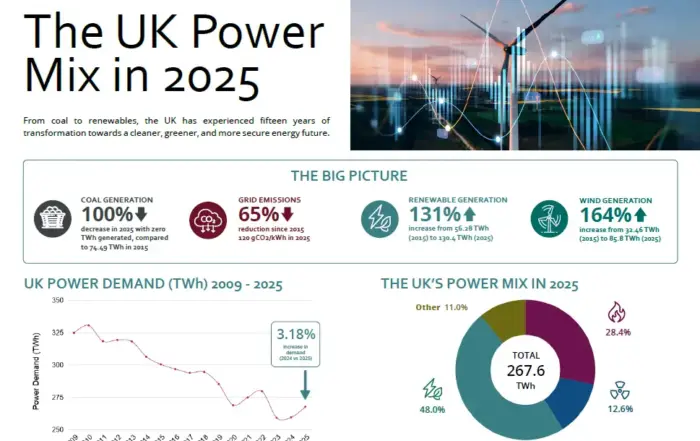
UK Power Generation Mix in 2025
The UK Power Mix in 2025 How the UK’s electricity system has been transformed Over the past 15 years, the UK electricity system has undergone one of the fastest [...]

Technical Energy Cost Structures and Their Impact on Energy Strategy
How Technical Energy Cost Structures Are Redefining Energy Strategy When boards turn their attention to energy, the conversation almost always begins in the same [...]

Why energy procurement risk is no longer just a cost decision
Why energy procurement risk is no longer just a procurement issue For many senior leaders, energy still appears in the P&L as a cost [...]