

Why Capacity and kVA settings matter more than ever for manufacturers
For many manufacturers, capacity and kVA settings sit in the background. They are agreed when a site is connected and maybe adjusted if or when major equipment changes are implemented. They are rarely discussed at board level, where attention typically focuses on unit rates, contracts, and consumption.
That approach made more sense under the previous charging framework, but it makes far less sense in 2026.
The shift in charging methodology
Historically, a meaningful portion of transmission charges was influenced by time-of-use demand, particularly the Triad periods. Businesses that understood when the system was under stress could influence part of their exposure.
Following Ofgem’s Targeted Charging Review (TCR), that structure changed. A significant share of residual network costs is now recovered through fixed, capacity-based charges linked to connection voltage and agreed capacity bands.
In simple terms, more of your electricity bill is now determined by how your meter is classified than by when you use energy.
From April 2026, as RIIO-ET3 begins and TNUoS residual revenues increase sharply, those fixed charges will rise again. What was once marginal becomes material.
What capacity and kVA actually control
Every half-hourly meter is assigned an agreed capacity, measured in kVA. That capacity sits within a defined band. The band determines the level of fixed residual charges applied per meter, per day.
This is not a measure of annual consumption. It reflects the level of demand the network must be ready to support.
A business can have multiple meters at one facility. Each meter attracts its own standing and residual charges, and each sits within its own band.
That structure means two things:
Where businesses can be unintentionally exposed
There are several common scenarios where manufacturers overpay without realising it.
Some sites are misaligned because historic capacity agreements were never updated after operational change. Electrification, process redesign, on-site generation, or meter consolidation can materially alter demand without triggering a formal capacity review.
Other sites sit close to the upper or lower edge of their assigned band. Being near a threshold can increase exposure or limit flexibility if demand shifts.
And in some cases, businesses consistently underuse their agreed capacity. After efficiency projects or production changes, the headroom originally required is no longer necessary, yet the band, and associated daily charge, remains unchanged.
None of these issues are operational failures. They are classification issues.
Why this matters more from April 2026
The impact of capacity and banding decisions has grown because the charging balance has shifted.
With residual charges increasingly recovered through fixed per-meter daily rates, and with those rates rising significantly from April 2026 onwards, banding has a larger influence on total cost.
For manufacturers with multiple meters, the exposure is multiplied. For those in higher voltage or higher capacity bands, the step changes are more pronounced.
In this environment, capacity settings are no longer technical housekeeping. They directly alter the bottom line.
Efficiency does not remove the need for review
Energy efficiency projects reduce kWh. They often reduce the maximum demand (i.e. peak loads) as well. But unless agreed capacity and banding are reviewed alongside or as part of the efficiency project, the fixed charging framework means that these costs will remain the same.
This is why businesses can improve operational performance and still feel financial pressure from network charges. The savings are real. The charging structure simply has not been revisited.
Efficiency should therefore act as a trigger for a technical sense-check. When demand profiles change, capacity agreements should be examined alongside them.
Capacity as part of the technical layer
Capacity and kVA settings sit within the technical layer of an energy strategy. They define part of the fixed cost base on which operational and commercial decisions rest. If misaligned, they can dilute savings achieved elsewhere. If reviewed deliberately, they can improve cost stability at a time when fixed network charges are rising.
As the UK’s transmission recovery continues to shift toward capacity-based charging, ignoring banding becomes increasingly difficult to justify.
If you want to understand whether your capacity and kVA settings still reflect how your sites operate, and whether rising residual charges are amplifying technical exposure, an Energy Exposure Assessment can help.
Connect with us
More energy insight from EnergyIntel

Energy Security 2026: Managing Energy Market Risk
Energy Security in 2026: What Businesses Can Control in a Volatile Energy Market Geopolitical instability, volatile gas markets and structurally high UK electricity costs [...]

How a foil manufacturer uncovered £4 million in energy savings
How one foil manufacturer put £4 million back into the business The way energy is bought, managed and accounted for can have a significant impact on operating costs, [...]

How hidden energy costs led to £3 million of savings for one UK glass recycler
How One Glass Recycler Turned Hidden Energy Costs Into £3 Million of Savings Most businesses assume they're paying the right amount for their energy. It's one of those [...]
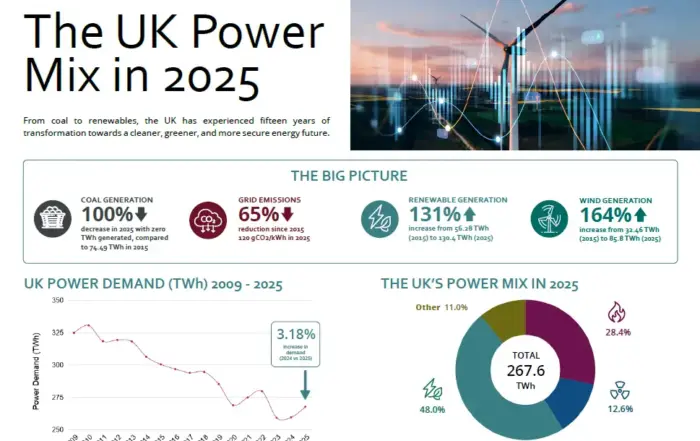
UK Power Generation Mix in 2025
The UK Power Mix in 2025 How the UK’s electricity system has been transformed Over the past 15 years, the UK electricity system has undergone one of the fastest [...]

Technical Energy Cost Structures and Their Impact on Energy Strategy
How Technical Energy Cost Structures Are Redefining Energy Strategy When boards turn their attention to energy, the conversation almost always begins in the same [...]

Why energy procurement risk is no longer just a cost decision
Why energy procurement risk is no longer just a procurement issue For many senior leaders, energy still appears in the P&L as a cost [...]